The Dust Bowl: A Historical Context
During the 1930s, the Dust Bowl was an environmental disaster that profoundly impacted the American Midwest. It was characterized by severe dust storms resulting from drought and poor agricultural practices. The effects were widespread, causing significant economic hardship and displacing thousands of families.
The Walton Family: Affected by the Dust Bowl
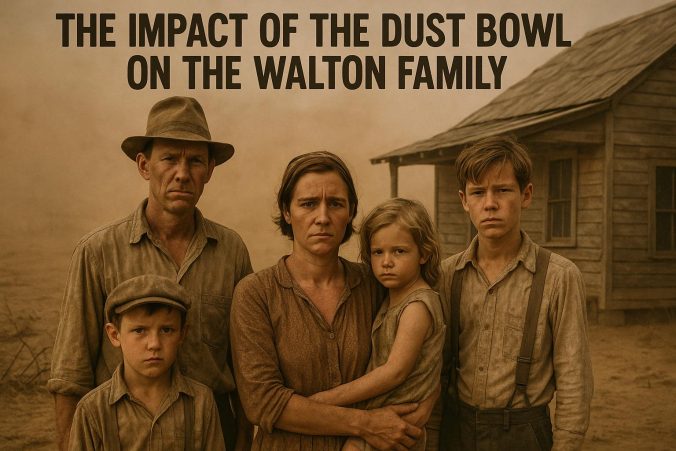
The Walton family, like many others during this period, faced significant challenges due to the Dust Bowl. They lived in the impacted region and relied heavily on agriculture for their livelihood. The adverse environmental conditions and economic distress forced many such families to reconsider their futures.
Economic Hardships
Loss of Crops: The Waltons, primarily dependent on farming, experienced substantial crop failures over successive years. The dust storms rendered large swaths of farmland unusable, diminishing yields and, consequently, their income.
Increased Debt: To cope with the loss of income, the Walton family, like others, took out loans to sustain their living and farming operations. However, the persistence of the Dust Bowl conditions made it increasingly difficult to repay these debts, creating a cycle of financial instability.
Migration and Relocation
Faced with diminishing prospects in the Midwest, many families, including the Waltons, were compelled to migrate in search of better opportunities. Some moved to urban centers, while others headed westward to states like California, hoping for employment in burgeoning industries.
Social Implications and Legacy
The socio-economic effects of the Dust Bowl on the Walton family extended beyond financial distress. The experience instilled a resilience that would shape their decisions in subsequent years as they adapted to a changing environment.
These challenges set the stage for future generations, influencing how they managed land and resources. The lessons learned during the Dust Bowl became part of the narrative for entire communities, emphasizing the necessity for sustainable agricultural practices and the importance of environmental conservation to combat similar crises in the future.
Understanding the Causes of the Dust Bowl
The formation of the Dust Bowl was the result of a combination of weather patterns and human actions over a long period. While droughts are natural occurrences, the impact thereof was amplified by agricultural practices that were not sustainable or considerate of the local ecosystem’s limitations.
Environmental Factors
The environmental aspect of the Dust Bowl emanated from extended periods of drought that occured in the Midwest. The semi-arid climate of the Great Plains made the region especially susceptible to such dry spells. When the rains stopped, the condition of the soil quickly deteriorated. The lack of moisture made the soil loose, and it became highly vulnerable to erosion by wind.
Agricultural Practices
Prior to the 1930s, the Great Plains was subjected to aggressive farming techniques. Fields were plowed extensively without considering the potential consequences on soil health. Large portions of native grassland were converted into farmland, exposing fragile topsoil to potential damage. With the grass removed, the soil lacked the natural protection that prevented it from being easily eroded.
Government Policies
The American government at the time encouraged settlement and farming in the Great Plains, inadvertently accelerating the calamity that would be known as the Dust Bowl. Without proper knowledge of or experience with the region’s unique environment, farmers were incentivized to keep expanding their agricultural activities, often exploiting the soil beyond its capacity.
Technological Limitations
The technology available to the farmers during the pre-dust bowl era was not advanced enough to predict climate patterns accurately or develop informed agricultural methods. As such, technological limitations also played a role in the mismanagement of land resources leading up to the Dust Bowl.
The Widespread Impact of the Dust Bowl
The ramifications of the Dust Bowl were extensive, crossing social, economic, and environmental boundaries. It not only affected those living in the immediate area but had repercussions on a national scale as well.
Economic Impact
In the aftermath of the Dust Bowl, the economic downfall was immediate and severe. Agricultural production declined sharply, leading to a national food shortage. The inability to produce crops decimated farmers’ incomes and by extension, had a cascading effect on the entire economy.
Demographic Shifts
With farms becoming unviable, population movements were inevitable. Mass maritime-like migrations to uninvolved regions, especially the West, were common. Families left behind farmland in hopes of gaining stability elsewhere, reshaping demographic landscapes in both their departure and arrival areas.
Cultural Developments
The ordeal of the Dust Bowl wouldn’t go unnoticed in culture and media. It inspired numerous works of art and literature that captured the challenges of the era. The struggle and resilience during this ordeal became embedded in cultural history, influencing both art and an understanding of human tenacity in the face of adversity.
Policy and Reform
The Dust Bowl starkly highlighted the need for better land management and environmental policies. As a result, set guiding principles were established for future agricultural practices. New Deal programs initiated by President Franklin D. Roosevelt prompted efforts to restore the Dust Bowl region and prevent such catastrophes from occurring again. Programs focused on soil conservation, afforestation, and sustainable farming were initiated to guide future policy development.
For a deeper understanding of how the Dust Bowl changed environmental policy in America, you might look into official records and archived government reports available from national repositories.
The Long-term Legacy of the Dust Bowl
The enduring legacy of the Dust Bowl reaches beyond immediate crises or resolutions, influencing environmental and social consciousness throughout the United States.
Shift in Agricultural Practices
The Dust Bowl served as a urgent call for reconsidering agricultural techniques. It raised awareness around sustainable farming, emphasizing the necessity of crop rotation, cover cropping, no-till farming, and other practices that prioritize maintaining soil health. This bred a mindset of sustainability in farming techniques that continues today.
Impact on Environmental Conservation
A heightened awareness of environmental preservation can be attributed to the lessons learned from the Dust Bowl. Since then, there’s been a stronger push towards conserving natural resources, understanding ecological limits, and integrating environmental considerations into developmental plans.
Resilience in Agricultural Communities
Many families, like the Waltons, were left with no choice but to adapt or relocate. This created a tapestry of stories about resilience as communities banded together to face unprecedented challenges. These narratives reinforced the value of communal aid and shared experience, spawning a collective spirit that still influences communities today.
Educational Importance
The Dust Bowl serves as an essential case study in environmental science, economics, and history curricula. Its story teaches the ramifications of unchecked human activity on natural resources and highlights adaptive strategies in crisis management. This historical episode continues to provide valuable lessons for current and future generations.
The impact of the Dust Bowl extends beyond statistics or map boundaries; it’s woven into the fabric of American history. Exploring its legacy through different lenses helps in understanding not only past adversities but also how resilience and reform can lead to sustainable futures.